


Content block block-960263902-1791575660
"While the food supply in the United States is one of the safest in the world, the Centers for Disease Control and Prevention (CDC) estimates that each year roughly 1 in 6 Americans (or 48 million people) gets sick, 128,000 are hospitalized, and 3,000 die of foodborne diseases." www.cdc.gov
The top five risk factors for foodborne illness outbreaks are:
- Improper cooling or heating of perishable food items
- Improper cooking temperatures of food
- Dirty and/or contaminated utensils and equipment
- Poor employee health and hygiene
- Food from unsafe sources
When food is being prepared in a private home or by a food facility operator, having one or more of these risk factors present dramatically increases the risk of a foodborne illness outbreak. If one risk factor is observed in a retail food facility, it constitutes a major violation and must be immediately corrected. Often the correction involves the destruction of food products to minimize the risk of transmitting a foodborne illness to the public.
1. Improper cooling or heating of perishable food items.
Keeping foods cold or hot minimizes the growth of any pathogenic bacteria that may be present in the food. Many foods have bacteria present – but keeping foods cold enough or hot enough helps prevent that bacteria from growing. Why does this matter? Because the number of bacteria that a person ingests has a direct impact on a possible illness. A small number of disease-causing bacteria may cause a mild illness or possibly no illness at all. However, a large number of the same bacteria may cause a very severe illness.
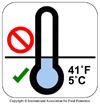 Potentially hazardous foods that are going to be stored at cold temperatures (i.e. refrigerated) must be kept at a temperature of 41°F or below. Examples of “cold-holding methods” include walk-in coolers, prep coolers, cold top tables, holding foods on ice, refrigerated displays, and the use of refrigerated trucks. It is important that the temperature of the food itself be 41°F or below at all times. Foods in a cooler that reads 40°F in the morning before the facility opens may be well above 41°F during a lunch rush when the
 cooler door constantly opening and closing.
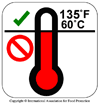
Potentially hazardous foods that are going to be kept at hot temperatures must be held at a temperature of 135°F or above. Examples of “hot holding methods” include steam tables, crock pots, heat lamps, double boilers, and hot holding cases/cabinets.
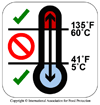
The temperature range between 41°F and 135°F is called the danger zone. Food facility operators must take every precaution to minimize the amount of time that potentially hazardous foods spend in that danger zone.
 This also applies to the cooling and reheating of potentially hazardous foods. When cooling hot foods for later use, they must be rapidly cooled. This means that the temperature must come down from 135°F to 70°F within 2 hours, and then from 70°F down to 41°F within 4 additional
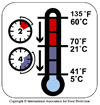 hours. At the end of the 6-hour period, the food must be at or below 41°F.
When reheating cold foods to make them hot and able to be served throughout the day, they must be rapidly reheated. This means that potentially hazardous foods must be reheated to 165°F within 2 hours before being placed in a steam table or some other hot holding unit. (No icon available)
2. Improper Cooking Temperatures of Foods
Cooking food to the proper temperatures is extremely important because many raw meats naturally have pathogenic bacteria, such as salmonella on raw chicken. Cooking is the only food preparation step that will kill bacteria. Proper holding temperatures slow down bacteria reproduction, freezing food makes bacteria go dormant, but proper cooking temperatures will kill bacteria in the food. When cooking foods, ensure that the proper temperature is reached by using an accurate probe thermometer to measure the center of the food. Once the proper cooking temperature has been achieved, ensure that the food remains at or above that temperature for at least 15 seconds to make sure that most, if not all, of the bacteria are eliminated.
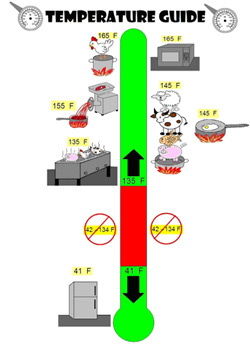 Cook the following foods to the listed minimum temperatures:
- Raw poultry such as chicken, duck, and turkey-165°F
- Raw ground meats such as ground beef and sausage-155°F
- Raw pork, fish, eggs, lamb, and whole pieces of beef-145°F
- Fruits and vegetables prior to hot holding-135°F
3. Dirty or Contaminated Utensils and Equipment
 When utensils or equipment become dirty or contaminated, they can transfer that contamination to the food causing a foodborne illness. This may occur in different ways. If utensils or equipment are not cleaned frequently, and old food residue is allowed to build up at room temperature, bacteria in the residue may multiply rapidly and contaminate any food that comes into contact with it. To prevent this from happening, utensils, food preparation equipment, and food contact surfaces should be washed, rinsed, and sanitized at least once every 4 hours. This can be done manually in a 3-compartment sink, in a mechanical dish machine, or through a clean-in-place procedure for large pieces of equipment.
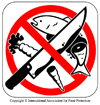 A specific kind of contamination can occur when ready-to-eat foods come into contact with raw animal products or their juices. This is called cross-contamination. When preparing different kinds of foods, a food worker must take great care to ensure that ready-to-eat foods do not come into contact with raw animal products or anything else that raw animal products have touched (unless that object or surface has already been washed, rinsed, and sanitized). It is possible for cross-contamination to occur due to contaminated utensils, food contact surfaces, and unwashed hands. Care also needs to be taken in storing raw animal products in a refrigerator. Raw animal products must be stored below and away from ready-to-eat foods to prevent any possible dripping or leaking from the raw food container that may cause cross-contamination.
Utensils, equipment, and food contact surfaces may also become contaminated by other means. If they come into contact with dirty mop water, garbage, pesticides, or sewage, that could potentially cause illness.
4. Poor Employee Health and Hygiene
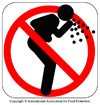
It is imperative that food workers are in good health while preparing food. A food worker that has been diagnosed with an acute gastrointestinal illness (GI), or is showing symptoms such as diarrhea, or vomiting in conjunction with diarrhea, could potentially contaminate food. It is possible for a food worker to transfer their illness to customers via the food. Employees working with large batches of food may spread their illness to numerous people causing an outbreak.
The Person in Charge (PIC) of the food facility is responsible for the health of their employees. The PIC must restrict an employee from working with exposed food, clean equipment, utensils, linens, and unwrapped single-use articles if they are suffering from symptoms of an acute GI. Food workers should also be restricted from working with these items if they are coughing and sneezing, and medicine is not helping. Additionally, any cuts, sores, or open wounds on the hands and arms must be properly bandaged, covered, and the food worker must wear gloves. The PIC is also required to exclude from the food facility any employees that are diagnosed with one of the following illnesses by a doctor:
- Salmonella typhi.
- Salmonella spp.
- Shigella spp.
- Entamoeba histolytica
- Enterohemorrhagic or shiga toxin producing Escherichia coli.
- Hepatitis A virus
- Norovirus
The PIC is responsible for notifying Orange County Environmental Health if any of its employees have been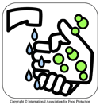 diagnosed with one of these diseases. The PIC shall also report when two or more food employees experience acute gastrointestinal illness at the same time. Only the Orange County Environmental Health or the Orange County health officer may remove an exclusion imposed due to the diagnosis of one of these illnesses.
Proper hand washing goes "hand-in-hand" with employee health when preventing foodborne illness outbreaks. Foodborne illnesses are often caused by food workers contaminating their hands and then touching food or other food contact surfaces without first washing their hands. It is imperative to wash your hands before touching food, utensils, or food contact surfaces in each of these instances to prevent spreading foodborne illness:
- When you first arrive at work and enter the kitchen
- After using the restroom
- After sneezing or coughing
- After touching any other part of the body (i.e. hair or face) besides your hands and the exposed part of your arms that were previously washed
- After handling any raw animal products (i.e. raw meat and raw eggs)
- After performing any non-food preparation related activity such as taking out the garbage, eating, drinking, smoking, using pesticides, washing dirty utensils, using a phone, or handling money
Thorough hand washing is important to ensure that all contamination has been removed. Proper hand washing shall be done with warm water and soap for a minimum of 10 - 15 seconds. A nail brush may be necessary to get any dirt underneath the fingernails. The hands shall then be dried using disposable paper towels or a hot air blow drier.
Proper glove use is an excellent tool for protecting food from contamination. However, the use of gloves must follow strict guidelines, or else food becomes contaminated as if gloves were not used. These guidelines include:
- A food worker must wash their hands before putting on a clean pair of gloves
- Gloves must be changed every time that a food worker would otherwise be required to wash their hands
- Gloves must be changed when they have become damaged or deteriorated
- Single-use gloves are to be discarded after use and may not be reused
5. Food From Unsafe Sources
Any food that is to be sold, served, given away, or used as an ingredient, must be obtained from an approved source. An approved source is a facility where the food is produced, prepared, or processed, and meets or exceeds the standards of the responsible regulatory agency. This commonly means that the facility has a valid permit and is inspected on a regular basis by a regulatory agency. The regulatory agency may be Orange County Environmental Health, but it may also be other agencies such as the U.S. Food and Drug Administration (FDA) or the United States Department of Agriculture (USDA).
Even when the source you purchase food from is approved, it is still advisable to know exactly how they handle the food before it reaches you. When receiving food, check it to make sure that it is at the proper temperatures, that it is not infested with any kind of vermin, and that it has not been adulterated in any way. If the food has been temperature abused, is infested, or has been adulterated, do not accept the delivery. Since it can be difficult to tell if fresh produce has been contaminated prior to delivery, ensure that it is always washed prior to being cut, cooked, prepared, and served.
Links in this section relate to Body