

Content block block-1297099217-1792197107

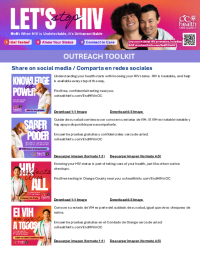
Let’s Stop HIV Together (Together) campaign is the CDC’s national campaign of the Ending the HIV Epidemic in the U.S. (EHE). This evidence-based campaign was created in English and in Spanish that aims to empower communities, partners, and health care providers to reduce HIV stigma and promote HIV testing, prevention, and treatment.
Accordion section
HIV testing is an important part of staying healthy, for individuals, their partners, and the broader community. The CDC recommends that everyone between the ages of 13-64 get tested for HIV at least once as part of routine health care. For those at higher risk, more frequent testing is encouraged.
Even in committed relationships, getting tested together is a smart step. Knowing one’s HIV status empowers individuals to make informed decisions and take control of your health

Free Testing at:
17th St. Testing, Treatment and Care
1725 W. 17th Street
Santa Ana, CA 92706
(714) 834-8269
AltaMed
1325 N. Anaheim Blvd., Ste. 200
Anaheim, CA 92801
(714) 500-0491
APAIT
12832 Garden Grove Blvd, Suite E
Garden Grove, CA 92843
(714) 636-1349
Families Together Orange County
11180 Warner Ave. Suite #353 and #257
Fountain Valley, CA 92708
1(800) 597-7977
LGBTQ Center OC
1605 N. Spurgeon
Santa Ana, CA 92701
(714) 953-5428
Radiant Health Centers
17982 Sky Park Circle, Suite J
Irvine, CA 92714
(949) 809-5700
TakeMeHome
Order your testing kit online at Takemehome.org
Links in this section relate to Body

Providers below offer PrEP/nPEP and PrEp Navigation:
17th St. Testing, Treatment and Care
1725 W. 17th Street
Santa Ana, CA 92706
(714) 834-8269
1227 W 17th St.
Santa Ana, CA 92706
(714) 760-4465
AltaMed
1325 N. Anaheim Blvd., Ste. 200
Anaheim, CA 92801
12751 Harbor Blvd.
Garden Grove, CA 92840
(714) 500-0491
APAIT
12832 Garden Grove Blvd, Suite E
Garden Grove, CA 92843
(714) 636-1349
Families Together Orange County
11180 Warner Ave. Suite #353 and #257
Fountain Valley, CA 92708
1(800) 597-7977
Radiant Health Centers
17982 Sky Park Circle, Suite J
Irvine, CA 92714
(949) 809-5700
To learn more about prevention options click the link below:
Let’s Stop HIV Together: Prevention
Links in this section relate to Body
What is HIV Treatment?
Antiretroviral therapy (ART) means taking medication exactly as prescribed by your healthcare provider. ART helps lower the amount of HIV in your body (your viral load) to very low levels, often to the point where it’s undetectable by standard test.
- There is no cure for HIV, but treatment can help you live a long, healthy life.
- Most people can reach an undetectable viral load within six months of starting treatment
- Undetectable=Untransmittable: When your viral load is undetectable, you cannot transmit HIV through sex. (See below)
- HIV treatment does not protect against other sexually transmitted diseases (STDs) like chlamydia, gonorrhea, or syphilis. Using condoms and getting tested regularly are still important.
Starting treatment early gives you the best chance to stay healthy and protect your partner. Talk to a provider and take the first step toward managing HIV with confidence.
U=U: Undetectable = Untransmittable
When someone living with HIV takes their medication correctly and keeps an undetectable viral load, they can’t pass HIV to their partner(s) through sex. It’s one of the best ways to stay healthy, reduce stigma, and protect others.
Why It Matters & What to Know
- Getting on HIV medicine as soon as possible and staying on it regularly gives the best chance to become undetectable, often within about six months.
- “Undetectable” doesn’t mean HIV is gone. The virus is still in the body, but at such low levels that a test can’t see, and it can’t be passed through sex.
- To stay undetectable, it’s important to keep taking medicine, go to health care visits, and get regular blood tests (viral load tests).
More OC HIV Treatment Resources
Links in this section relate to BodyWhen community supports individuals living with HIV, it makes it easier for them to lead healthy lives. The Together campaign aims to uplift the voices of people living with HIV (PLWH) and highlights the importance that each person, within communities, plays in stopping HIV stigma.
What is Stigma?
HIV Stigma refers to negative attitudes and beliefs about people living with HIV. It often stems from misinformation, fear, or prejudice, and can lead to harmful behaviors and discrimination.
Stigma happens when people are unfairly judged or labeled because of their HIV status or even just the perception that they might have HIV. This can discourage individuals from getting tested, seeking treatment, and/or talking openly about their health.
Some examples are:
- Assuming that only certain groups of people can get HIV
- Judging people who use HIV prevention methods, like PrEP or condoms
- Believing someone “deserves” to get HIV because of their lifestyle or choices
What are the effects of Stigma:
- Affects emotional well-being and mental health of PLWH
- Internalization of stigma and develop a negative self-image
- Individuals take negative ideas and stereotypes and apply them to themselves which may lead to feelings of shame, fear of disclosure, isolation, and despair
- Create fear of being discriminated against or judged
What can be done?
Normalizing conversations about HIV will allow the opportunity to correct misinformation and misconceptions about HIV. Here is a guide to learn how to carry conversations with others about HIV:
Stigma Language Guide
OC Stigma Reduction Plan